Biscayne National Park is a U.S. National Park located in southern Florida, south of Miami. The park preserves Biscayne Bay and its offshore barrier reefs, some of the best scuba diving and snorkeling areas in the United States. Ninety-five percent of the park is water, and the shore of the bay is the location of an extensive mangrove forest. The park covers 172,971 acres and includes Elliott Key, the park's largest island and first of the true Florida Keys, formed from fossilized coral reef. The islands farther north in the park are transitional islands of coral and sand. The offshore portion of the park includes the northernmost region of the Florida Reef, one of the largest coral reefs in the world.
Source: flickr.com/photos/radiology/4532403238/in/photostream/
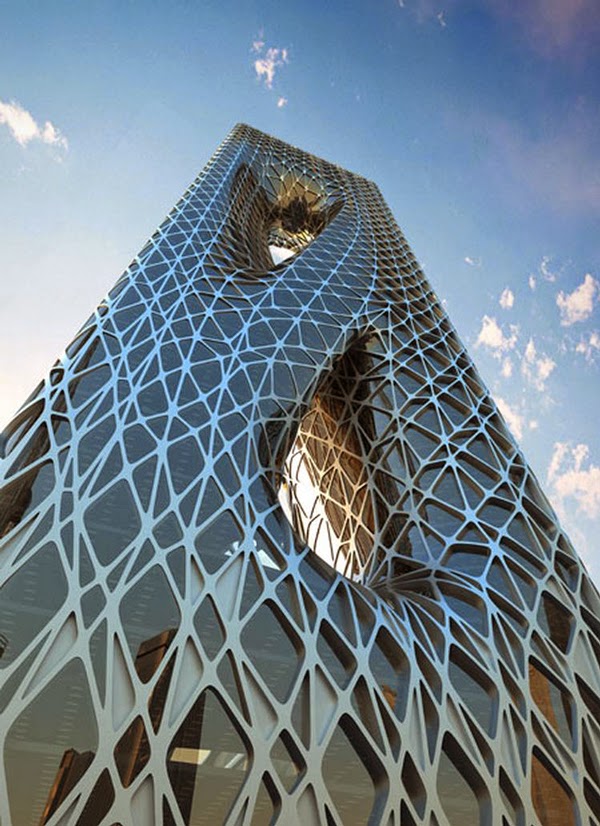
Zaha Hadid Architects’ design for Sunrise Tower engages with the city in multiple ways. By exploring potential synergies at different levels and anchoring itself to the existing urban fabric, it creates a platform of services that engage with neighbouring developments, sustaining critical mass and a sense of community. The scheme merges all programmes into one building, distancing itself from the traditional tower and podium typology. Through a detailed landscape strategy the design interweaves tower and ground, extending and connecting the different parts of the site, integrating the new pedestrian routes and internal road system, structuring the fabric of the new development. Source: zaha-hadid.com/architecture/sunrise-tower
The Arch of Titus is a 1st-century honorific arch located on the Via Sacra, Rome, just to the south-east of the Roman Forum. It was constructed in c. 82 AD by the Roman Emperor Domitian shortly after the death of his older brother Titus to commemorate Titus' victories, including the Siege of Jerusalem in 70 AD. The Arch of Titus has provided the general model for many of the triumphal arches erected since the 16th century perhaps most famously it is the inspiration for the 1806 Arc de Triomphe in Paris, France, completed in 1836.
The arch is large with both fluted and unfluted columns, the latter being a result of 19th century restoration. The spandrels on the upper left and right of the arch contain personifications of victory as winged women. Between the spandrels is the keystone, on which there stands a female on the East side and a male on the West side. The soffit of the axial archway is deeply coffered with a relief of the apotheosis of Titus at the center. The sculptural program also includes two panel reliefs lining the passageway within the arch. Both commemorate the joint triumph celebrated by Titus and his father Vespasian in the summer of 71.
Source: flickr.com/photos/27420180@N08/10051267984
Source: 500px.com/photo/58974144
The Petronas Towers, also known as the Petronas Twin Towers are twin skyscrapers in Kuala Lumpur, Malaysia. According to the Council on Tall Buildings and Urban Habitat (CTBUH)'s official definition and ranking, they were the tallest buildings in the world from 1998 to 2004. The buildings are a landmark of Kuala Lumpur, along with nearby Kuala Lumpur Tower.
The main bank of Otis Lifts is located in the centre of each tower. All main lifts are double-decker with the lower deck of the lift taking passengers to even-numbered floors and upper deck to odd-numbered floors. To reach an odd-numbered floor from ground level, passengers must take an escalator to the upper deck of the lift. There are 29 double-deck passenger elevators, but there are different sets that service certain floors of the towers, specifically two sets of six of these double-deck passenger elevators to floors 1-23 and 1-37 respectively. Another set of 5 passenger lifts transport passengers to the 41st and 42nd floors where they can switch lifts to reach the upper zones of the buildings, each double-deck passenger lift with the capacity of 52 passengers or, 26 passengers per deck. There are also 6 heavy-duty elevators for utility.
Source: flickr.com/photos/43116531@N06/6153560572#
Source: 500px.com/photo/16217699/petronas-towers-in-kuala-lumpur-malaysia-by-toonman-blchin
The Space Needle is an observation tower in Seattle, Washington, a landmark of the Pacific Northwest, and a symbol of Seattle. It was built in the Seattle Center for the 1962 World's Fair, which drew over 2.3 million visitors, when nearly 20,000 people a day used its elevators. Once the tallest structure west of the Mississippi River, it is 605 ft high, 138 ft wide, and weighs 9,550 tons. It is built to withstand winds of up to 200 miles per hour and earthquakes of up to 9.1 magnitude, as strong as the 1700 Cascadia earthquake. It also has 25 lightning rods.
It has an observation deck at 520 ft and a gift shop with the rotating SkyCity restaurant at 500 ft. From the top of the Needle, one can see not only the downtown Seattle skyline but also the Olympic and Cascade Mountains, Mount Rainier, Mount Baker, Elliott Bay, and surrounding islands. Photographs of the Seattle skyline often show the Space Needle prominently, above the rest of the skyscrapers and Mount Rainier. Visitors can reach the top of the Space Needle by elevators that travel at 10 miles per hour. The trip takes 41 seconds, and some tourists wait in hour-long lines. On windy days, the elevators slow to 5 miles per hour. On April 19, 1999, the city's Landmarks Preservation Board designated it a historic landmark.
Source: deviantart.net/fs41
Source: flickr.com/photos/55274249@N04/5506013197/in/set-72157626091261903