These unique trees of up to 16 storeys in height can be found all around the Gardens - twelve at the Supertree Grove, while the remaining six are placed in clusters of threes at the Golden and Silver Gardens. Providing scale and dimension to the Gardens while marrying the form and function of mature trees, the Super-trees also create height to balance the tall developments in the Marina Bay area. Take a stroll along the OCBC Skyway, a 128-metre long walkway with a height of 22-metres that connects two Super-trees at the Supertree Grove, and take in a different view of the Gardens. Chill out at the 50-metre Supertree-top bistro and be captivated by the panoramic views of the Gardens as well as the surrounding Marina Bay area. Over 162,900 plants comprising more than 200 species and varieties of bromeliads, orchids, ferns and tropical flowering climbers are planted on the Super-trees. OCBC Bank is the largest sponsor of Gardens by the Bay to date, with sponsorship of OCBC Skyway and the OCBC Garden Rhapsody. When night falls, watch as the Super-trees come alive with a dazzling myriad of light displays bursting across the sky.


Shiprock is a census-designated place (CDP) in San Juan County, New Mexico, United States, on the Navajo reservation. The population was 8,156 at the 2000 census. It is part of the Farmington Metropolitan Statistical Area. Shiprock is named after the nearby Shiprock rock formation. It is home to the annual Northern Navajo Fair, held every October. Since 1984, the community has been the host of the Shiprock Marathon and Relay. It is also home to a campus of Diné College (formerly Navajo Community College), a tribally controlled community college with seven other campuses across the Navajo Nation. It is the site of a Chapter House for the Navajo, a Bureau of Indian Affairs agency, the Northern Navajo Medical Center (an Indian Health Service hospital), and a branch of Farmington Public Library. Shiprock is a key road junction for truck traffic and tourists visiting the Four Corners, Mesa Verde, Shiprock and the Grand Canyon. The town lies at the intersection of U.S. Highway 64 and U.S. Highway 491 (formerly U.S. Highway 924).

Source: fineartamerica.com/products/shiprock-inge-johnsson-poster.html
Biscayne National Park is a U.S. National Park located in southern Florida, south of Miami. The park preserves Biscayne Bay and its offshore barrier reefs, some of the best scuba diving and snorkeling areas in the United States. Ninety-five percent of the park is water, and the shore of the bay is the location of an extensive mangrove forest. The park covers 172,971 acres and includes Elliott Key, the park's largest island and first of the true Florida Keys, formed from fossilized coral reef. The islands farther north in the park are transitional islands of coral and sand. The offshore portion of the park includes the northernmost region of the Florida Reef, one of the largest coral reefs in the world.
Source: flickr.com/photos/radiology/4532403238/in/photostream/
Sceaux is a commune in the southern suburbs of Paris, France. It is located 9.7 km from the center of Paris. The Château de Sceaux is a grand country house in Sceaux, Hauts-de-Seine, not far from Paris, France. Located in a park laid out by André Le Nôtre, it houses the Musée de l’Île-de-France, a museum of local history. The former château was built for Jean-Baptiste Colbert, Louis XIV's minister of finance, who purchased the domaine in 1670. The present château, designed to evoke the style of Louis XIII, dates from the Second Empire. Some of Colbert's outbuildings remain, and the bones of the garden layout.
During the French Revolution the property was confiscated as a bien national, its contents sold for the benefit of the nation, and the building bought by M. Lecomte, a merchant of Saint-Malo. Under the Consulat, the original château was demolished, but the pavilion of Aurore, the Orangerie, the stables, and outbuildings were preserved. Crops were grown on Le Nôtre's terraces.
Source: pariscotejardin.fr/2012/04/le-jardin-de-lorangerie-du-parc-de-sceaux-hauts-de-seine/
The Jindai Botanical Garden is at the edge of the Musashino plateau just above Jindaiji Temple in Chōfu, Tokyo, Japan. It extends across 425,433 square meters, and each of its thirty areas features varieties of one kind of plant. Displays of ume, cherries, azalea, dogwood, peonies, roses, wisteria or other can be seen every month. In front of the temple below there is also a wetland annex for aquatic plants, where irises are cultivated. The garden has 100,000 trees and shrubs representing approximately 4,500 varieties, each with an identifying label. The park has a plant protection program to preserve endangered Japanese species and exhibitions and activities related to gardening for the benefit of local citizens. Just outside the rear gate there is an area where some plants are sold.
The site of Jindai Botanical Garden was once part of a medieval fortress said to date from 1537. Later it was a nursery that supplied trees for Tokyo's streets. After the war it was opened to the public as Jindai ryokuchi (green area) and in 1961 it was given its current name as it became the first botanical garden in Tokyo. A large greenhouse was built in 1984 holding the collection of tropical plants. In one section of the greenhouse is the lily pond. Downhill from the garden is Jindaiji Temple, the second oldest one in Tokyo.
Source: flickr.com/photos/y_ogawa/13639110005/in/photostream/
Klevan contains the ruins of Klevan Castle, whose construction began in 1475 and was eventually completed in 1561. The town also houses the Church of the Annunciation with a bell tower dating back to 1630, as well as the Church of the Nativity, which was built in 1777. There is also Klevan Railway station, which connects the town with the oblast's administrative center Rivne and Kivertsi, as well as a woodworking plant and food-processing facilities. An amusement railway (and walkway for lovers) called Tunnel of Love is also located near Klevan.
Source: 500px.com/photo/25665469/klevan-tunnel-of-love-by-volodymyr-gryniuk
Skradinski buk is one of the most attractive parts of the park. It is a massive, clear, natural pool with high waterfalls at one end and cascades at the other, located in the Krka National Park in Croatia. It is the lowest of the three sets of waterfalls formed along the Krka river. In an area 400 m in length and 100 m in width there are 17 waterfalls and the total difference in height between the first and the last falls is 47.7 m. Due to the wealth and variety of geomorphological forms, vegetation, and the various effects caused by the play of light on the whirlpools, Skradinski buk is considered to be one of the most beautiful calcium carbonate waterfalls in Europe. The rate of flow is 43 m3 a second in winter, 18 m3 in summer, with an average of 55 cubic metres a second flowing down Skradinski buk annually. It is the largest travertine cascade system in Europe.
When you are at the Krka National Park there are several places of interest. The attractions and facilities available are various footpaths, sightseeing tours and presentations, boat trips, souvenir shops, a museum, and restaurants. There are also several archeological remains of unpreserved fortresses in the park's vicinity dating back to as far as the Roman times. They are Čučevo, Nečven, Bogočin, Ključica and Burnum.
Source: flickr.com/photos/rkroenert/10156092003/
Source: 500px.com/photo/4880600/krka-waterfall-by-dusan-milak
Source: flickr.com/photos/sergiu_bacioiu/4404273656/
The Construction of a Orchideorama should come up of the relation between architecture and the living organisms. It should not make any distinction between natural and artificial, on the contrary, it should accept them as a unity that allows architecture to be conceived as a material, spatial, environmental organization that is deeply related to the processes of life.
Source: archdaily.com/832/orquideorama-plan-b-architects-jprcr-architects/
Windsor Castle is a royal residence at Windsor in the English county of Berkshire. The castle is notable for its long association with the British royal family and for its architecture. The original castle was built in the 11th century after the Norman invasion by William the Conqueror. Since the time of Henry I, it has been used by succeeding monarchs and it is the longest-occupied palace in Europe. The castle's lavish, early 19th-century State Apartments are architecturally significant, described by art historian Hugh Roberts as "a superb and unrivalled sequence of rooms widely regarded as the finest and most complete expression of later Georgian taste". The castle includes the 15th-century St George's Chapel, considered by historian John Robinson to be "one of the supreme achievements of English Perpendicular Gothic" design. More than five hundred people live and work in Windsor Castle.
Source: cristimoise.net
Source: flickr.com/photos/hoodj1234/5604494042/in/photostream/
Source: sheitoonak.com
Source: flickr.com/photos/white-rhino/3114581022/
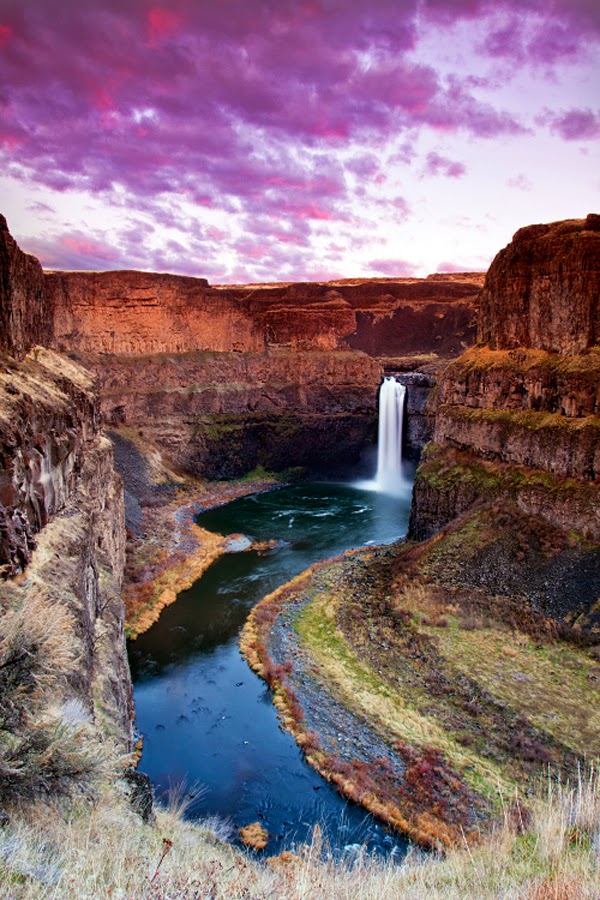
The Palouse Falls lies on the Palouse River, about 4 mi upstream of the confluence with the Snake River in southeast Washington, United States. The falls are 198 ft in height. The falls consists of an upper falls with a drop of ~20 feet which lies 1,000 feet north northwest of the main drop, and a lower falls, with a drop of ~180 feet. The falls are included in Washington State's Palouse Falls State Park, which provides access to the falls and has displays explaining the region's unique geology, as well as its historical ties (the Palouse Indians and the Mullan Road both took advantage of the easy access to the plateau in the vicinity of the falls).
Source: 500px.com/photo/9990571/palouse-falls-by-paul-james
Source: 500px.com/photo/39342650/palouse-falls-portrait-by-michael-brandt
Source: flickr.com/photos/craiggoodwin2/8542133679/in/photostream
Source: 500px.com/photo/11387003/palouse-by-s-amer
The White Sands National Monument is a U.S. National Monument located about 25 km southwest of Alamogordo in western Otero County and northeastern Doña Ana County in the state of New Mexico, at an elevation of 4235 feet. The area is in the mountain-ringed Tularosa Basin and comprises the southern part of a 710-km² field of white sand dunes composed of gypsum crystals. It is the largest gypsum dune field in the world.
Gypsum is rarely found in the form of sand because it is water-soluble. Normally, rain would dissolve the gypsum and carry it to the sea. The Tularosa Basin is enclosed, meaning that it has no outlet to the sea and that rain that dissolves gypsum from the surrounding San Andres and Sacramento Mountains is trapped within the basin. Thus water either sinks into the ground or forms shallow pools which subsequently dry out and leave gypsum in a crystalline form, called selenite, on the surface. Groundwater that does flow out of the Tularosa Basin flows south into the Hueco Basin. During the last ice age, a lake known as Lake Otero covered much of the basin. When it dried out, it left a large flat area of selenite crystals which is now the Alkali Flat. Another lake, Lake Lucero, at the southwest corner of the park, is a dry lake bed, at one of the lowest points of the basin, which occasionally fills with water.
Source: menaker.com/photo/1119
Source: russbishop.photoshelter.com/gallery-image/Signature-Series-Fine-Art-Prints/G0000VcaKKF6NLWU/I000040eQbPlYbKo
Source: flickr.com/photos/gakout/6143653393/sizes/l/in/photostream/
Ladera was once part of Rabot Estate, one of Soufrière's oldest and most famous cocoa plantations. In 1982 it was transformed into the unique resort it is today. Taking full advantage of its natural surroundings, Ladera offers a unique design in guest accommodations. The 32 suites all have an "open wall" the west side of each unit is left open to expose the breathtaking view, and the orientation of the buildings maintains complete privacy. The suites are constructed of tropical hardwoods, stone and tile, furnished with 19th century French furniture or replicas, wicker and accessories crafted by local artisans. All units are decorated with local artwork and feature magnificent views of the Pitons and Caribbean Sea.
The exquisite freshness and inventive flavors of the fresh local cuisine at Dasheene? Dining in the open air, high above the Caribbean Sea? The sumptuous pleasures of The Spa? The welcoming island hospitality offered by the entire staff. Maybe lounging on warm sand on the beach at the base of the Pitons? Or possibly, what you will remember is simply the magically serene experience of being so separate from the rest of the world, surrounded by the sounds of the rainforest, at one with Ladera, and embracing all that it has to offer.
As part of Ladera's complimentary services, guests may also enjoy the hot tubs in the spa gardens, conveniently located beside the spa. Ladera guests may include a hot soak as part of their pre- or post-massage routine, or simply use it to relax after a day hiking or spent at the beach. Their trained esthetics staff and massage therapists look forward to providing you with the rest, relaxation and pampering that has become their hallmark. Source: www.ladera.com
Source: erdekesvilag.hu
Source: westernoriental.com
Source: takequickbreak.com
Rising majestically above the 600 acre beach front resort of Anse Chastanet, Jade Mountain St.Lucia is a cornucopia of organic architecture celebrating St Lucia’s stunning scenic beauty. Architect owner Nick Troubetzkoy has expanded upon his philosophy of building in harmony with Caribbean nature in his creation of Jade Mountain St.Lucia. The bold architectural design individual bridges leading to exceptional infinity pool sanctuaries and rugged stoned-faced columns reaching towards the sky makes Jade Mountain St.Lucia one of the Caribbean’s most mesmerizing resort experiences.
Expect grand sweeping spaces where bedroom, living area and an extravagant private infinity pool glide into one another to form extraordinary platforms floating out into nature. With the fourth wall entirely absent, Jade Mountain’s sanctuaries are stage-like settings from which to embrace the full glory of St Lucia’s Pitons World Heritage Site, and of course, the eternal Caribbean Sea. A wide range of spa services can be enjoyed in the privacy of the Jade Mountain sanctuaries or at Kai en Ciel, Jade Mountain’s boutique spa and fitness studio. Source: www.jademountain.com
Source: gloholiday.com/top-10-resorts-in-caribbean
Source: christopherfowler.co.uk
Source: jetsetter.com/trips/st-lucia/st-lucia/163/jade-mountain
Source: condenasttraveler.tumblr.com
Source: johannastuxgren.blogspot.com
Each of Viceroy St Lucia resort's Luxury Sugar Mill Rooms, Luxury Villas, Luxury Beachfront Bungalows, and Residences affords spectacular views of the Pitons or the Caribbean Sea. The indulgent world-class Rainforest Spa, full PADI dive facility, sumptuous waterfront dining, and chic bars and lounges ensure the quintessential St Lucia resort vacation experience, all close to the isle’s top tourist attractions. Offering space enough for families and honeymooners alike, Sugar Beach, St Lucia is the premier choice among Soufriere hotels for discerning travelers seeking seclusion and tranquility amid unsurpassed natural beauty.
From the finest international cuisine to delightfully casual tropical tastes, you’ll find exceptional culinary choices to please every palate at Sugar Beach, A Viceroy Resort on St Lucia’s scenic southwest coast. Set within over 100 acres of tropical rainforest with awe-inspiring views of the Caribbean and St Lucia’s dramatic twin Pitons, the resort’s celebrated collection of dining experiences is more than equal to the view.
Cradled in the embrace of St Lucia’s World Heritage-listed Pitons, it is hard to imagine a location more conducive to relaxation and rejuvenation than the Rainforest Spa at Sugar Beach, A Viceroy Resort. Widely regarded as the island’s spiritual heart, the lush foliage and soaring mountain vistas of Val des Pitons provide the perfect backdrop for St. Lucia spas. Guests wishing to unwind can experience a period of re-creation in its truest sense - a time for reflection, renewal and a break from the everyday stresses of life.
www.viceroyhotelsandresorts.com
Source: islands.com
Source: vacationidea.com
Source: flickr.com/photos/drhutchinson/150247376/
Source: thesweet7.com
Source: midlandsmusings.com