Bokod is the lake in Hungary, some 80 kilometers west of Budapest. It’s an interesting and beautiful place. Plenty of old fishing houses on the water which look rather romantic with the various wooden bridges. Bokod Hungary is not a tourist destination. It is barely visited – it’s just an old village on a lake. Along the lake shore, rickety boardwalks lead out over the lake to old fishing cottages that stand on stilts. It’s not the nicest location, but I think there’s something enchanting about the photographs, and there is certainly something artsy about the boardwalks and cottages on the misty water.
Schaerbeek is one of the nineteen municipalities located in the Brussels-Capital Region of Belgium. The first mention of the name was Scarenbecca, recorded in a document from the Bishop of Cambrai in 1120. The origin of the name may come from the Franconian (Old Dutch) words schaer (notch, score) and beek. Schaerbeek is nicknamed "the city of donkeys". This name is reminiscent of times when people of Schaerbeek, who were cultivators of sour cherries primarily for Kriek production, would arrive at the Brussels marketplace with donkeys laden with sour cherries. Donkeys are still kept in Josaphat Park and sour cherry trees line the streets of the Diamant Quarter of Schaerbeek (Avenue Milcampslaan, Avenue Emile Maxlaan and Avenue Opale/Opaallaan). The Square des Griottiers/Morelleboomsquare is named after these trees.
Source: flickr.com/photos/quoirin/3061244447
Shiprock is a census-designated place (CDP) in San Juan County, New Mexico, United States, on the Navajo reservation. The population was 8,156 at the 2000 census. It is part of the Farmington Metropolitan Statistical Area. Shiprock is named after the nearby Shiprock rock formation. It is home to the annual Northern Navajo Fair, held every October. Since 1984, the community has been the host of the Shiprock Marathon and Relay. It is also home to a campus of Diné College (formerly Navajo Community College), a tribally controlled community college with seven other campuses across the Navajo Nation. It is the site of a Chapter House for the Navajo, a Bureau of Indian Affairs agency, the Northern Navajo Medical Center (an Indian Health Service hospital), and a branch of Farmington Public Library. Shiprock is a key road junction for truck traffic and tourists visiting the Four Corners, Mesa Verde, Shiprock and the Grand Canyon. The town lies at the intersection of U.S. Highway 64 and U.S. Highway 491 (formerly U.S. Highway 924).

Source: fineartamerica.com/products/shiprock-inge-johnsson-poster.html
In place names the town bank term is reserved for deeply lining the Grand Canal and the Bacino di San Marco . At the time of the Venetian Republic in fact the existing banks were the quays for berthing of vessels that operated the mercantile trade in the Mediterranean basin . For this reason, the banks are characterized by a width much greater than that of fondamente ordinary and are totally devoid of parapets. The banks are the most famous Riva di Biasio or Biagio, the Riva del Vin and Riva del Carbón along the Grand Canal ; the Riva degli Schiavoni and the Riva dei Sette Martyrs along the Bacino di San Marco .
Source: flickr.com/photos/37759772@N07/10852348584
Málaga is a city and a municipality, capital of the Province of Málaga, in the Autonomous Community of Andalusia, Spain. With a population of 568,507 in 2010, it is the second most populous city of Andalusia and the sixth largest in Spain. This important cultural infrastructure and the rich artistic heritage have culminated in the nomination of Málaga as a candidate for the 2016 European Capital of Culture. The internationally acclaimed painter and sculptor Pablo Picasso, Hebrew poet and Jewish philosopher Solomon Ibn Gabirol and actor Antonio Banderas were born in Málaga. The magnum opus of Cuban composer Ernesto Lecuona, "Malagueña", is named for the music of this region of Spain.
The most important business sectors in Málaga are tourism, construction and technology services, but other sectors such as transportation and logistics are beginning to expand. The Andalusia Technology Park (PTA), located in Málaga, has enjoyed significant growth since its inauguration in 1992. Málaga is the main economic and financial centre of southern Spain, home of the region's largest bank, Unicaja, and the fourth-ranking city in economic activity in Spain behind Madrid, Barcelona and Valencia.
Source: flickr.com/photos/luigmarin/2980207881/in/pool-1059838@N24/
In a maritime country like Greece, the god of the sea was bound to occupy a high position in the divine hierarchy. In power, Poseidon was considered second only to Zeus (Jupiter), the supreme god himself. His implacable wrath, manifested in the form of storms, was greatly feared by all mariners. In an age without mechanical power, storms very frequently resulted in shipwrecks and drownings. The temple at Cape Sounion, Attica, therefore, was a venue where mariners, and also entire cities or states, could propitiate Poseidon, by making animal sacrifice, or leaving gifts.
The temple of Poseidon was constructed in 444-440 BC, over the ruins of a temple dating from the Archaic Period. It is perched above the sea at a height of almost 60 m. The design of the temple is a typical hexastyle i.e. it had a front portico with 6 columns. Only some columns of the Sounion temple stand today, but intact it would have closely resembled the contemporary and well-preserved Temple of Hephaestus beneath the Acropolis, which may have been designed by the same architect.
Source: flickr.com/photos/ayiomamitis/4738365402/
Source: flickr.com/photos/tzil/7413522844/
Discover Marriott's Maui Ocean Club - Molokai, Maui & Lanai Towers in beautiful Ka'anapali Beach. A jewel amongst Ka'anapali beach resorts, It's located in one of the most desirable destinations in Maui. Their guestrooms, one- and two-bedroom suites at this stunning beach resort in Maui offer elegance and comfort in an ideal location. Featuring an array of fabulous amenities unrivaled by other Ka'anapali beach resorts, their spacious suites include separate living and dining areas, a wet bar with bar-sized refrigerator, sink and dishwasher, and private balconies with scenic views. Enjoy the fantastic 3.5-acre superpool, rejuvenating on-site spa and wellness center, several nearby golf courses, a premium fitness center and many great dining options. Ideally located in Lahaina, Maui beach resort is just moments away from premier attractions like Whalers Village, Front Street and Lahaina Cannery Mall. Discover luxurious suite accommodations at Hawaiian beach resort at Marriott's Maui Ocean Club.
Spacious Lahaina beach resort accommodations and appealing amenities include eclectic dining, golf, tennis and watersports. Families will love the 3.5-acre super pool with slides, waterfalls, grottos, spas and a shipwreck play area for children. Beautiful Lahaina, Maui beach resort overlooks Ka'anapali Beach and is located within proximity of top attractions. Source: www.marriott.com
Source: flickr.com/photos/67281146@N08/6577522493
The sunflower (Helianthus annuus) is an annual plant grown as a crop for its edible oil and edible fruits (commonly called "sunflower seeds"). Sunflower is also used as bird food, as livestock forage (as a meal or a silage plant) and in some industrial applications. The plant was first domesticated in the Americas. Wild Helianthus annuus is a widely branched annual plant with many flower heads. The domestic sunflower, however, possesses a single large inflorescence (flowering head) atop an unbranched stem. The name sunflower derives from the flower head's shape, which resembles the Sun. Sunflower seeds were brought to Europe from the Americas in the 16th century, where, along with sunflower oil, they became a widespread cooking ingredient.
Source: 500px.com/photo/10330309/sunflow-by-maría-llorens
Veronica House was a great opportunity to explore the relationship between Peruvian architecture and international styles. The intervention was also seen as the meeting between the artificial and the natural. The nearly 40 meters long pool and a multi-level staircase allowed integration with the landscape. The swimming pool is on a raised platform, carved into the hill, with a glass enclosure based on a rail system. Intimate areas are accommodated in a volume of two levels that "floats” above the terrace. The materiality of the house is articulated with the balanced use of five main materials: Cast stone concrete, with colors derived from natural rock sources.
Source: architizer.com/projects/lefevre-beach-house/
Capitol Reef National Park is a United States National Park, in south-central Utah. It is 100 miles long but fairly narrow. The park, established in 1971, preserves 241,904 acres and is open all year, although May through September are the most popular months. Called "Wayne Wonderland" in the 1920s by local boosters Ephraim P. Pectol and Joseph S. Hickman, Capitol Reef National Park protects colorful canyons, ridges, buttes, and monoliths. About 75 mi of the long up-thrust called the Waterpocket Fold, a rugged spine extending from Thousand Lake Mountain to Lake Powell, is preserved within the park. "Capitol Reef" is the name of an especially rugged and spectacular segment of the Waterpocket Fold near the Fremont River. The area was named for a line of white domes and cliffs of Navajo Sandstone, each of which looks somewhat like the United States Capitol building, that run from the Fremont River to Pleasant Creek on the Waterpocket Fold. The local word reef referred to any rocky barrier to travel. Easy road access came with the construction in 1962 of State Route 24 through the Fremont River Canyon.


Source: flickr.com/photos/nwade615/3604733291/in/set-72157619404572016/
Puerto Viejo de Talamanca is a small coastal town in Caribbean Costa Rica in the province of Limón. It is popular with surfers and backpackers. This is an area where foreigners are buying and building. There are two gorgeous National Parks nearby - Cahuita and Manzanillo, and it rains more than on the Pacific side, which is why it is so lush and green with the rainforest coming down to the sea. Clear water, coconut palms, great surf and a laid-back Caribbean atmosphere make Puerto Viejo a favorite among travelers. Located on the Caribbean Coast, about an hour south of Limon, Puerto Viejo is the center of activity between the smaller villages of Cahuita and Manzanillo. The relaxed, seaside town is framed by jungle, turquoise seas, banana plantations and scenic rivers.
Formerly a small fishing village, Puerto Viejo has grown rapidly in recent years. Avid surfers, drawn to the famous Salsa Brava waves, have made Puerto Viejo a hotspot on the surfing circuit. The center of town now has many souvenir and surf shops, bars, restaurants, hotels and tour companies. True to its beach location and Caribbean ambiance, bikes and pedestrians dominate road traffic along the coastal roads. With its blend of Afro-Caribbean descendants, expat Europeans and indigenous Costa Ricans, Puerto Viejo charms visitors with a unique mix of people and cultures. Rastafari culture has a firm foothold in the town, and many Rastas sell handmade jewelry and other wares along the town’s vibrant roadside.
Byron Bay is a beachside town located in the far-northeastern corner of the state of New South Wales, Australia. It is located 772 kilometres north of Sydney and 165 kilometres south of Brisbane. Cape Byron, a headland adjacent to the town, is the easternmost point of mainland Australia. At the 2006 Census, the town had a permanent population of 4,981. The town is in turn the nucleus of Byron Shire, which has in excess of 28,000 residents. The local Arakwal Aboriginal people's name for the area is Cavvanbah, meaning "meeting place". Captain James Cook named Cape Byron after John Byron, circumnavigator of the world and grandfather of the poet, Lord Byron. The town has several beaches which are popular for surfing. It is a resort popular with both domestic and international tourists, including backpackers, who travel along the Australian coast; the scenery also attracts skydivers. The area is also noted for its wildlife, with the whale watching industry a significant contributor to the local economy.
An oceanway runs from the centre of town to the Cape Byron lighthouse. This allows visitors to walk and cycle to the lighthouse. Temperate and tropical waters merge at Byron Bay, making it a popular area for scuba diving and snorkelling. Most diving is done at Julian Rocks which is part of the recently established Cape Byron Marine Park and only a few minutes boat ride from Main Beach. Byron Bay also lies close to subtropical rainforests, and areas such as the Nightcap National Park with the Minyon Falls are all within easy reach of the town. Byron Bay is now also a popular destination for Schoolies week during late November and early December.
Source: designsof.com
Strome Castle is a ruined castle on the shore of Loch Carron in Stromemore, 3.5 miles south-west of the village of Lochcarron, on the west coast of the Scottish Highlands. Originally built by the Macdonald Earls of Ross. Later in 1472 the castle was owned by the Clan MacDonald of Lochalsh and Alan MacDonald Dubh, 12th Chief of the Clan Cameron was constable on behalf of the MacDonalds of Lochalsh. In 1539 King James V of Scotland granted the castle to the Clan MacDonnell of Glengarry and Hector Munro, chief of the Clan Munro was constable of the castle for the MacDonalds of Glengarry.
Later in 1602 the castle was besieged by Kenneth Mackenzie, 1st Lord Mackenzie of Kintail, chief of the Clan Mackenzie, assisted by their allies the Clan Matheson. After the MacDonalds surrendered it was demolished and blown up. The MacDonnells of Glengarry built a new castle called Invergarry Castle. In 1939 the ruined Strome Castle was presented to the National Trust for Scotland. Today the castle comprises a courtyard and the remains of a square tower.
Source: 500px.com/photo/21934709/strome-castle-ruins-by-gavin-johnson
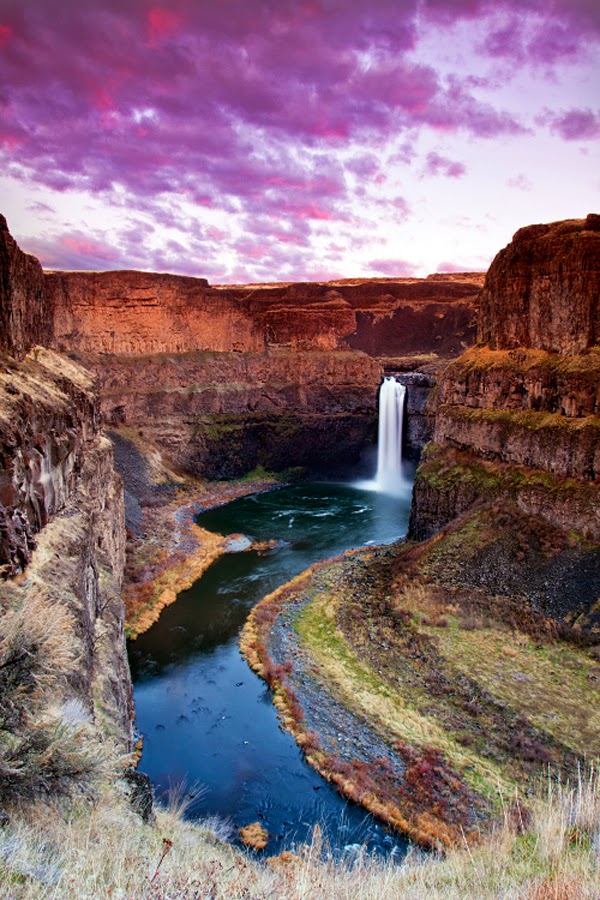
The Palouse Falls lies on the Palouse River, about 4 mi upstream of the confluence with the Snake River in southeast Washington, United States. The falls are 198 ft in height. The falls consists of an upper falls with a drop of ~20 feet which lies 1,000 feet north northwest of the main drop, and a lower falls, with a drop of ~180 feet. The falls are included in Washington State's Palouse Falls State Park, which provides access to the falls and has displays explaining the region's unique geology, as well as its historical ties (the Palouse Indians and the Mullan Road both took advantage of the easy access to the plateau in the vicinity of the falls).
Source: 500px.com/photo/9990571/palouse-falls-by-paul-james
Source: 500px.com/photo/39342650/palouse-falls-portrait-by-michael-brandt
Source: flickr.com/photos/craiggoodwin2/8542133679/in/photostream
Source: 500px.com/photo/11387003/palouse-by-s-amer
Source: 500px.com/photo/4168701
The Twelve Apostles is a collection of limestone stacks off the shore of the Port Campbell National Park, by the Great Ocean Road in Victoria, Australia. Their proximity to one another has made the site a popular tourist attraction. The apostles were formed by erosion: the harsh and extreme weather conditions from the Southern Ocean gradually eroded the soft limestone to form caves in the cliffs, which then became arches, which in turn collapsed; leaving rock stacks up to 45 metres high. The site was known as the Sow and Piglets until 1922 (Muttonbird Island, near Loch Ard Gorge, was the Sow, and the smaller rock stacks were the Piglets); after which it was renamed to The Apostles for tourism purposes. The formation eventually became known as the Twelve Apostles, despite only ever having nine stacks.
In 2002, the Port Campbell Professional Fishermens Association unsuccessfully attempted to block the creation of a proposed marine national park at the Twelve Apostles location, but were satisfied with the later Victorian Government decision not to allow seismic exploration at the same site by Benaris Energy; believing it would harm marine life.
Source: 500px.com/photo/44592360/twelve-apostles-revisited-by-bipphy-kath
Source: flickr.com/photos/brendanwaites/3481292011/